Songs for Polymede
A downloadable playable poem
Akrys anem kerym kunam / Prota valka Valkynarum
Kruda kaloquorom ota / Vasavayu kenyt pota
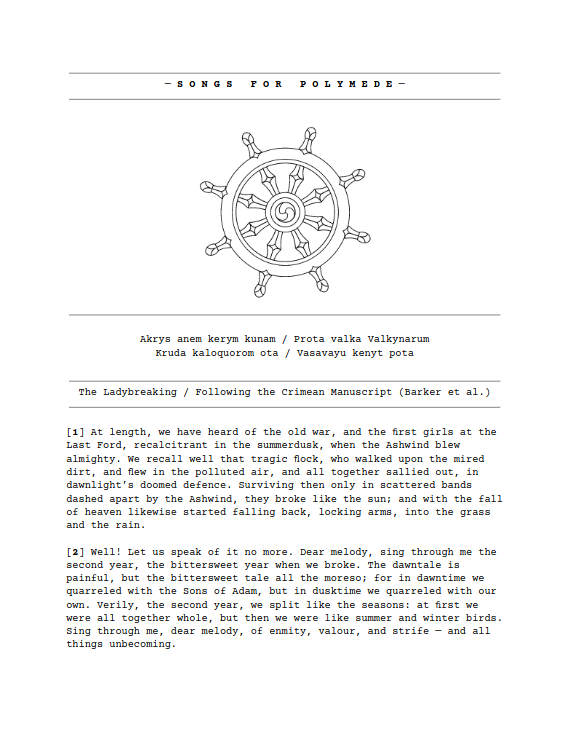
[1] At length, we have heard of the old war, and the first girls at the Last Ford, recalcitrant in the summerdusk, when the Ashwind blew almighty . . .
Songs for Polymede is a supplement for the original 1974 dungeon game (or its copy-left derivative, Fantastic Medieval Campaigns) created for the FMC Icon0clasm Ball. A mix of systems, prose-poetry, and campaign setting elements, Polymede presents a playful alternative mythology for adventure in the anachronistic past.
Here are some things I wanted to play with: translation, reception, national epic, comparative mythology, character class as sex-class, materialist history, colonial charter companies, merchant republics, mid-century roll-and-move resource transport games, and the symbolic language of the extreme right, esp. with regard to the proto-indo-european urheimat in the eurasian steppe.
Altogether, I think Polymede makes for an interesting heresy: not quite a ‘heathen’ attack on the text of the Dungeon Game, but rather, an attempt to read the Dungeon Game against itself by making some minimal changes and watching them proliferate. The various official variations on the Dungeon Game center boyhood fantasies: fantasies with adolescent erotics, nonsensical political econemy, and only a faint picture of adult masculinity. They are assuredly androcentric, but hardly patriarchal, for it is hard to find any women to rule over — or any good reason to rule them — in the peter-pan frontier. In this sense, the Dungeon Game is not really a traditionalist text. It is a boyish game, for men who want to be boys.
With Polymede, I have not tried to make a girlish game. Instead, I’ve tried to make a boyish game, for women, ex-tomboys, homosexuals, &c: anyone whose body cannot be ignored, whose sex presents itself as a problem, who can never quite escape the spectre of the domestic — who is nonetheless able to recall some fond occasion in childhood, when she wandered off into a field, and imagined herself a knight. We should here remember that the term ‘economics’ was first used in a domestic sense, i.e. ‘home economics’ . . .
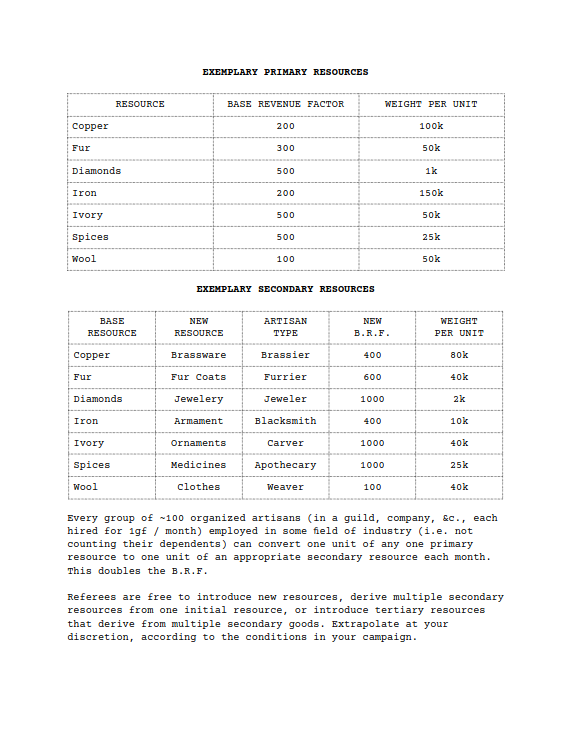
I have tried to present a world where the material situation constantly imposes itself on the realm of a naïve mythopoetic fantasy, which is despite all these difficulties, somehow still worth salvaging. If all of that seems a little weird or high-minded for your elfgame, well: I hope you like the resource rules! I think they’re pretty cool.
Songs for Polymede. Free tomboyish supplement for FMC (OD&D + Chainmail). Campaign setting & special rules & poetry.
Download
Click download now to get access to the following files:
Comments
Log in with itch.io to leave a comment.
Holy shit
I’m so excited to read this in depth after work—the premise itself is mindblowing, and I can’t wait to see how you engage with and synthesize those themes!
This is really special. I'm still digesting it.
Realized the resource base revenue factor is given without a unit of account. I think gold is obvious in context but I'll make it explicit it in the next version if I need to fix anything else :)
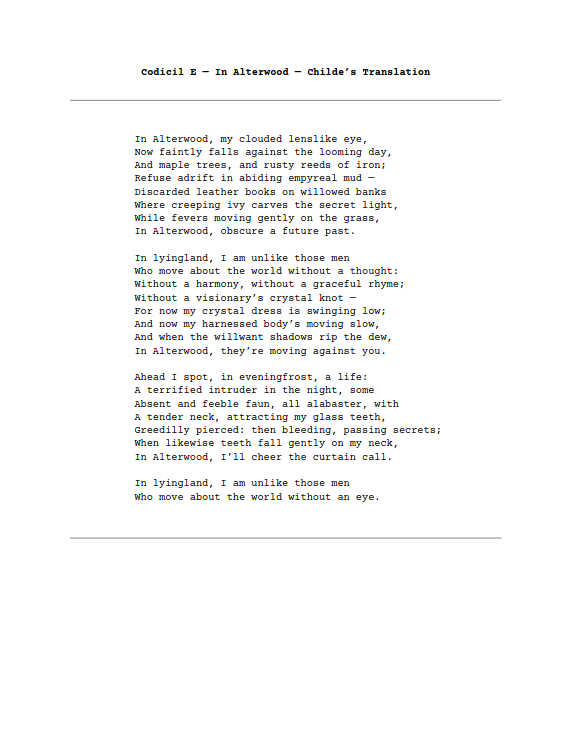
resolved, along with some typographical / copy mistakes in Codicil B ^^